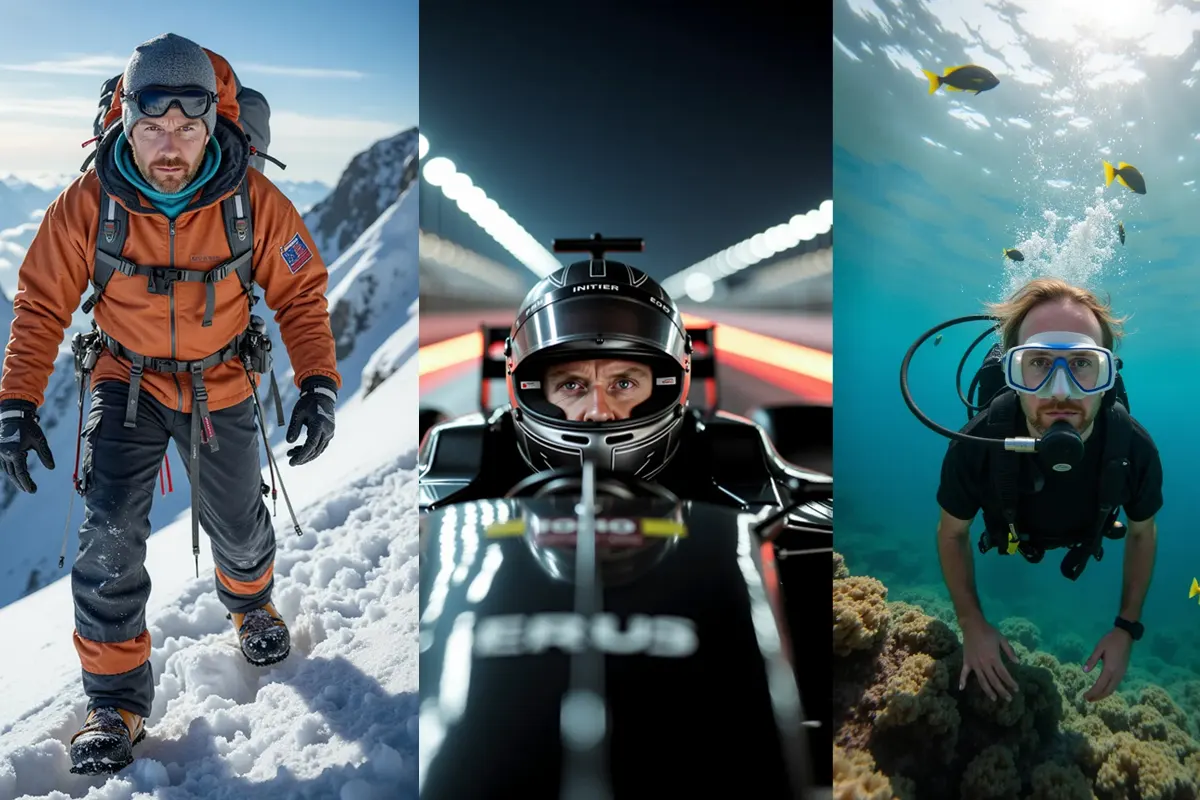
LoRA (Low-Rank Adaptation) is a fine-tuning method that teaches an existing AI image model something new, such as your face, by training a small add-on rather than the whole model. With a handful of good photos and one consumer graphics card, you can generate convincing images of yourself in almost any setting.
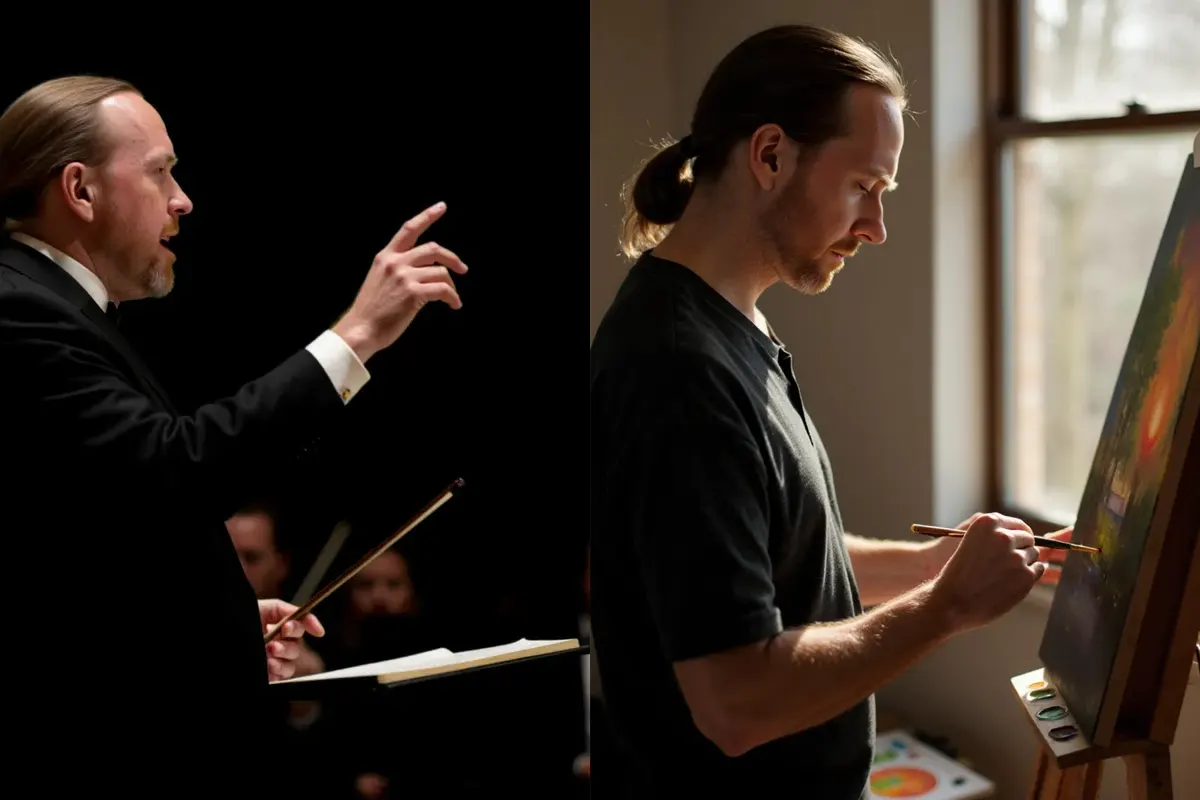
How we appear online matters more every year, and AI image generation can now do things that simply weren't possible a few years ago. One of the most interesting is making highly personalised images of a real person with LoRA training. This article covers what LoRA is, how it works, what it takes to train one on your own photos, and what to think about before you do.
What is LoRA?
LoRA stands for Low-Rank Adaptation. It was introduced by researchers at Microsoft in 2021 in the paper LoRA: Low-Rank Adaptation of Large Language Models (Hu et al.). As the title says, it was first designed for language models. The idea is simple: rather than retraining every weight in a large model, you freeze the original model and train a small set of extra weights that sit alongside it.
It wasn't long before the technique reached image models. Hugging Face credits developer Simo Ryu with the first LoRA implementation for Stable Diffusion, and LoRA support arrived in Hugging Face's diffusers library in January 2023. What you end up with is a small file, about 3 MB in Hugging Face's example, that you load on top of a base image model to teach it a person, an object or a style.
How did AI image generation get here?
Modern AI image generation traces back to generative adversarial networks (GANs), introduced by Ian Goodfellow and colleagues in 2014. Early GANs were hard to train, and they often produced obvious artefacts, unrealistic features and images that fell apart structurally. In 2017, researchers at NVIDIA published Progressive Growing of GANs, which trained at low resolution first and added detail step by step. It was a major jump in quality and stability.
The next shift was to diffusion models, which learn to turn random noise into an image one step at a time. Diffusion avoided much of the instability that plagued GANs. The latent diffusion paper behind Stable Diffusion (Rombach et al., 2021) showed that running the process in a compressed "latent" space significantly reduced the computing power needed compared with working on raw pixels. That's a big part of why capable image models can run on ordinary hardware, and why tools such as Stable Diffusion, DALL-E and Midjourney took off.
How does LoRA work?
Traditional fine-tuning changes every weight in the model. That takes a lot of memory and computing power, and with only a few training images it can easily overfit. LoRA takes a different approach. It leaves the original weights untouched and learns the change to them as the product of two much smaller matrices.
In the paper's notation, the adapted weights are W = W0 + BA, where W0 is the original, frozen weight matrix and B and A are small matrices whose product captures the adaptation. For a square n by n weight matrix and a chosen rank r, the number of values to train drops from n² to 2nr. Because r is usually tiny compared with n, that's a very large saving.
The paper reported that for GPT-3, LoRA cut the number of trainable parameters by 10,000 times and the GPU memory needed by three times, compared with full fine-tuning. It also found that a very small rank often performed competitively. In image models, LoRA is typically applied to the attention layers, which is why the resulting files are so small.
How do you create personal AI images with LoRA?
Good results start with good photos. The DreamBooth paper from Google Research showed that a model can learn a subject from "just a few images", and Hugging Face's guide says 5 or 10 are usually enough for DreamBooth-style training. Quality and variety matter more than the count. Here's a practical checklist:
- Use sharp, well-lit photos in which your face is clearly visible.
- Vary the angles, expressions, lighting, clothing and backgrounds, so the model learns you rather than one particular photo.
- Leave out photos with other people's faces in them, heavy filters or strong blur.
- Crop to the resolution the base model was trained at, for example 512 pixels square for the Stable Diffusion model in the Hugging Face example.
- Caption each image and include a unique trigger word, which you'll use in prompts later to call up your likeness.
What settings matter when training a LoRA?
The learning rate is the first setting to get right. Hugging Face's example uses 1e-4, which it notes is much higher than you'd use for full fine-tuning. Many training tools also let you lower the rate gradually over the run, for example on a cosine schedule.
The rank (sometimes called network dimension) and the alpha value control how much the LoRA can learn and how strongly it's applied. A higher rank gives it more capacity, but you get a bigger file and a greater risk of overfitting. There's no single right value. It depends on the base model, the subject and the tool, so start from your training tool's defaults and adjust from there.
Hardware needs are modest compared with full fine-tuning. Hugging Face's Stable Diffusion example ran in as little as 11 GB of GPU memory and took about five hours on a consumer RTX 2080 Ti. Larger base models and higher resolutions need more. Two standard techniques help when memory is tight: gradient checkpointing, which saves memory at the cost of some extra computation, and mixed precision training, which uses 16-bit numbers where it can and 32-bit where accuracy matters.
Where are personal AI images used?
Being able to generate consistent images of a specific person, product or style is useful well beyond novelty portraits. It's being used, or explored, in areas such as:
- E-commerce and retail: product visualisation and design iteration without a physical prototype, and virtual try-on of clothing and accessories.
- Custom merchandise: designs that follow a brand's look but are tailored to an individual customer.
- Entertainment and gaming: personalised avatars that keep a player's distinctive features across scenes and styles.
- Virtual influencers and characters: digital personalities that need to look the same in every piece of content.
- Marketing and advertising: versions of a campaign for different markets and audiences that keep the core brand elements.
What has changed since early 2025?
When this article first appeared in January 2025, training a LoRA was the most practical way to get an AI model to reproduce a particular face. It isn't the only route any more. Research such as InstantID (2024) showed identity-preserving generation from a single facial image. In August 2025, Google released Gemini 2.5 Flash Image with character consistency as a headline feature: keeping a person or product looking the same across different prompts and edits.
LoRA still has a place. A trained LoRA is a file you keep, it runs on your own hardware with open models, and it gives repeatable results across hundreds of images. For a one-off edit, though, a single reference photo in a general-purpose image model is often enough.
What comes next for LoRA?
Research into LoRA itself continues. AdaLoRA (2023) moves towards dynamic rank adaptation: rather than giving every layer the same rank, it shifts the budget towards the weights that matter most. Animation is another frontier. AnimateDiff (2023) adds a motion module that can be inserted into a personalised text-to-image model, turning it into an animation generator without retraining it.
Expect tighter integration with language models, so you can direct images in plain English. Expect better handling of several people or styles in one image, too, and faster, more automated training.
What are the risks of personal AI images?
The same technology that puts you on a mountain or behind the wheel of a race car can put someone else in a picture they never agreed to. Only train on your own likeness, or on someone who has given clear consent, and label AI-generated images as such when you share them. In Australia, the Criminal Code Amendment (Deepfake Sexual Material) Act 2024 made it a criminal offence to share sexual material depicting an adult online without their consent, including material created or altered with technology.
Conclusion
AI image generation and LoRA training are a real step forward for personalised digital content, and as the technology matures you'll see more sophisticated uses for it. Go in with a clear view of both what it can do and the responsibilities that come with it.
Better technology is only half of it. The other half is using these tools thoughtfully, in ways that respect people's rights while still pushing at what's creatively possible. Whatever comes next, the aim should be to create something of value, hold to sound ethical standards and innovate responsibly.